

In the digital car-buying world, your inventory photos are your showroom. Over 90% of vehicle shoppers start online, and according to a 2024 Cox Automotive study, good photography increases online engagement by up to 48%. That’s not a small difference — it’s the line between a lead walking into your lot or scrolling past your listing.
High-quality photos aren’t just “nice to have.” They directly influence how long a vehicle sits on your lot, the number of calls you receive, and the trust customers have in your dealership before they ever speak to you.
The 3P Vehicle Photo Framework: Proven to Boost Sales
Through work with Tier 3 dealerships, I’ve seen the same pattern over and over. The most successful online listings follow what I call the 3P Vehicle Photo Framework:
- Presentation – The car should look showroom-ready, inside and out. Clean, polished, and with no clutter in the background.
- Perspective – Multiple angles: front, back, side profiles, interior cabin shots, detail close-ups. According to AutoTrader, listings with 20+ images sell 32% faster than those with fewer than 10.
- Personality – Lifestyle images that help the customer picture the car in their own life.
When you consistently apply all three Ps, you give buyers more reasons to choose your listing over the one above or below it.
The Hard Numbers: Why Photo Quality Impacts Sales
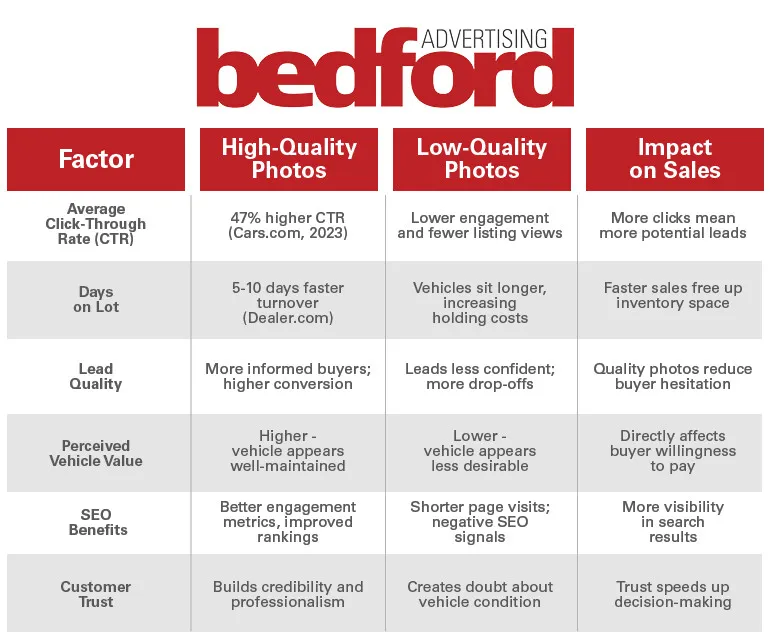
Many dealers suspect good photos help, but few realize just how much:
- Faster Turnover – Dealer.com reports that vehicles with professional photography sell 5–10 days faster on average.
- Higher Click-Through Rate (CTR) – Cars.com found that professional-quality listings get 47% more clicks than those with low-quality images.
- Better Lead Quality – Shoppers who spend more time on a VDP (Vehicle Detail Page) after browsing photos are more likely to submit contact info.
This isn’t just correlation — these numbers reflect buyer psychology. The more clearly and attractively a vehicle is presented, the less risk the buyer feels. Less risk = faster decision.
Common Photo Mistakes
Here’s where many dealerships lose ground to competitors — and often don’t even realize it:
- Dark, underexposed shots that hide the vehicle’s details.
- Inconsistent backgrounds that make the website look messy.
- Missing key angles (no interior shots, no cargo space images).
- Phone glare on windshields and chrome that looks unprofessional.
Each of these issues chips away at buyer trust. And once trust is gone, the sale is usually gone with it.
Matching Photos to Buyer Psychology
Different buyers respond to different cues. A family looking for a safe SUV wants to see a clean, spacious back seat and cargo area. A performance buyer wants close-ups of the wheels, exhaust tips, and interior dash.
By tailoring photos to the emotional triggers of each audience, you’re doing more than showing a car — you’re selling a lifestyle.
Example: For a truck buyer in a rural market, a shot of the truck bed loaded with gear can be more persuasive than the price alone. For a city commuter, a compact car parked in a tight downtown space communicates practicality and ease of use.
How Better Photos Improve SEO
Search engines don’t “see” images the way humans do, but they do measure engagement. If buyers click into your listing and spend time flipping through high-quality photos, that’s a strong positive signal.
Additionally:
- Optimized alt text with keywords (“2023 Ford F-150 Lariat – Leather Interior”) can help listings rank higher.
- Consistent image sizing improves page speed, which is now a Google ranking factor.
- Proper file naming (not “IMG_1234.jpg” but “2023-toyota-camry-se-blue.jpg”) adds search relevance.
This is where great visuals and smart SEO meet — and the result is more visibility for your inventory.
The ROI of Professional Photography
Let’s talk numbers. If you invest $500 a month in a professional photographer and that results in just one additional sale, the ROI is enormous. On a $30,000 vehicle with an average $2,000 gross profit, that’s a 300%+ return.
And because professional photos tend to shorten days on lot, you also save on holding costs, insurance, and floorplan interest. That means your photo investment doesn’t just make you more money — it keeps you from losing money.
Action Plan: Upgrading Your Dealership Photos
If you’re ready to improve your inventory presentation, here’s a clear path forward:
- Audit your current listings – How many images per vehicle? Are they consistent in lighting and background?
- Invest in proper equipment – A DSLR camera, tripod, and reflector panels can cost under $1,000.
- Create a shot list – Every car gets 20+ photos: exterior angles, interior, close-ups, lifestyle shots.
- Standardize your background – Clean, uncluttered, and consistent.
- Train or hire – Either train your team in basic photography or hire a dedicated photographer.
Why Buyers Choose Dealers Who Care About Presentation
In an age where car buyers do most of their research online, your photography is often the first and only “salesperson” they meet before walking in. A dealership that invests in great visuals communicates pride, professionalism, and attention to detail — all qualities buyers value when making a large purchase.
From sedans to heavy-duty trucks, every vehicle benefits from high-quality imagery. And your bottom line will too.
Written by Bella Arbelaez, Digital Content Specialist at Bedford Advertising where she develops engaging, SEO-optimized content for dealership clients across web, social, email, and ad platforms. She combines creative storytelling with data-driven strategy to boost brand visibility, connect with target audiences, and deliver measurable result