
BA.logo_.white_ 1

The NADA Show 2026 in Las Vegas confirmed what many have felt for months, the margin for error has officially evaporated. We are navigating a shifting economy where the traditional levers of dealership management are being tested by inconsistent hard and soft data. When job growth numbers conflict with sagging consumer sentiment, dealers cannot rely on intuition to protect their back-end profit. While consensus expectations do not point toward a deep recession, we are in a period of fiscal retrenchment. Trade policies and shifting interest rate cycles have created an environment where precision beats guesswork every time. To survive 2026, dealer principals must move past the hype and focus on the technical execution of data-driven strategies.

1. Artificial Intelligence: Moving from Buzzword to Utility

The industry has finally moved from “Tech Talk” to “Real Talk.” The conversation is no longer about whether AI exists, but whether your store’s data is unified. Fragmented systems—where the CRM, DMS, and service drive each only know a piece of the truth—are the primary inhibitors of profitability. By implementing a “Trigger-Intelligence-Action” loop, top performers are solving the problem of mistimed leads. Source data suggests that most leads aren’t dead; they are simply engaged at the wrong moment.

  • 3.2x faster close rates  for dealers with unified data.
  • 3x higher close rates  driven by AI-focused outreach.
  • 7% Reactivation Rate:  Perhaps the most critical lever in a high-CAC (Customer Acquisition Cost) environment, AI is successfully bringing back 7% of previously lost buyers. The top performers don’t guess. They connect, predict, and act.
2. Affordability and the Macro Economy

Affordability is the single greatest headwind facing the automotive retail sector. According to Equifax and QoreAI data, the APR landscape has created a bifurcated market that demands surgical precision in F&I.

The Current Interest Rate Landscape:

  • New Car APR:  7.3% (Prime) vs.  14.6% (Subprime)
  • Used Car APR:  9.6% (Prime) vs.  10.2% (Subprime)

Despite these staggering numbers and rising delinquencies, auto remains at the top of the consumer payment hierarchy. While Private Label Card originations have plummeted 11.5%  and Student Loans have dipped 0.2%,  Auto Loans and Leases are up 5.5% YoY.  Consumers are sacrificing other credit obligations to keep their keys, proving that the vehicle remains an essential asset even as labor market stresses and stubborn core price growth weigh on the household budget.

3. The Powertrain “Retrenchment”: Navigating Market Pressures

With average new vehicle transaction prices hovering at a sticky $49,766 , the consumer’s choice of powertrain has moved from lifestyle preference is a pure financial calculation. When a subprime buyer is starting down 14.6% APR, the decision between ICE, Hybrid, or EV is dictated by the monthly payment and total cost of ownership. Macro trade and fiscal policies are forcing a market-wide retrenchment where value-based choices are the only way to maintain volume.

4. The Tariff Wall

Tariffs are no longer a theoretical threat; they are a direct tax on the dealer’s lot. We anticipate a  4-8% price increase across all vehicle segments. However, one Senior Analyst’s view of the data reveals a significant competitive advantage for domestic production.

Projected Per-Vehicle Cost Impacts:

  • $5,000 for all imported vehicles.
  • $4,900 for imports specifically from Canada & Mexico.
  • $1,000 for US-assembled vehicles. Crucially, the impact on US-assembled units is down from  $3,000 due to new offsets. This creates a $2,000 cost-advantage gap for domestic-made units over imports, a delta that will likely define market share shifts throughout the 2026 cycle.
5. Defending the Franchise Model & Regulatory Wins

In a market defined by sticky prices, transparency is the dealer’s only weapon for building trust. Regulatory shifts and fiscal policy impacts have made consumers wary. The most successful franchises are demystifying digital retailing by translating complex tech into clear, customer friendly language. If you cannot lower the price due to macro pressures, you must increase the perceived value through a transparent, frictionless transaction process.

6. Inventory Management: Sticky Prices vs. Balanced Supply

The national days of supply metric suggests a return to normalcy, but the pricing data tells a different story. We are seeing a balanced lot with prices that refuse to budge.

Despite inventory levels being more balanced, price growth of 1.2% to 2.1% YoY remains persistent, requiring dealers to focus more on turn rate than high-margin “holding” strategies.

7. Service Retention Strategies

Fixed ops absorption is the lifeblood of the 2026 dealership. The Intelligence-to-Action loop is most effective here. For example, one case study following a major snowstorm showed that AI flagged 322 at-risk drivers due to tires or brakes, yielding a 14% booking rate. The real breakthrough is Early Defection Prediction. Modern AI models can now flag at-risk customers  90 days early, allowing for proactive messaging that prevents churn before the customer even considers an independent repair shop. This isn’t just service; it’s revenue defense.

What’s Next?

The transition to 2026 requires a move away from bad or outdated data. Success will be defined by the ability to unify systems, scale outreach, and measure profit through trained models rather than gut feel. The message from the NADA floor was clear:  “AI is already in your store! Train it or be trained by it.”

As a dealer, you must ask yourself:  In an era of 14% subprime APRs and $5,000 tariff impacts, is your data helping you predict the next move, or is it just recording the past?
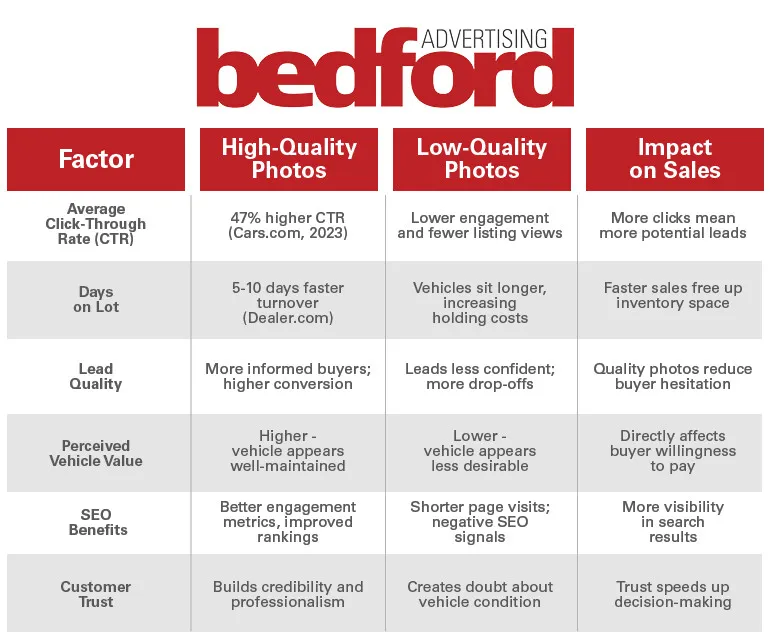
In the digital car-buying world, your inventory photos are your showroom. Over 90% of vehicle shoppers start online, and according to a 2024 Cox Automotive study, good photography increases online engagement by up to 48%. That’s not a small difference — it’s the line between a lead walking into your lot or scrolling past your listing.

High-quality photos aren’t just “nice to have.” They directly influence how long a vehicle sits on your lot, the number of calls you receive, and the trust customers have in your dealership before they ever speak to you.

The 3P Vehicle Photo Framework: Proven to Boost Sales

Through work with Tier 3 dealerships, I’ve seen the same pattern over and over. The most successful online listings follow what I call the 3P Vehicle Photo Framework:

  • Presentation – The car should look showroom-ready, inside and out. Clean, polished, and with no clutter in the background.
  • Perspective – Multiple angles: front, back, side profiles, interior cabin shots, detail close-ups. According to AutoTrader, listings with 20+ images sell 32% faster than those with fewer than 10.
  • Personality – Lifestyle images that help the customer picture the car in their own life.

When you consistently apply all three Ps, you give buyers more reasons to choose your listing over the one above or below it.

The Hard Numbers: Why Photo Quality Impacts Sales

Data chart

Many dealers suspect good photos help, but few realize just how much:

  • Faster Turnover – Dealer.com reports that vehicles with professional photography sell 5–10 days faster on average.
  • Higher Click-Through Rate (CTR) – Cars.com found that professional-quality listings get 47% more clicks than those with low-quality images.
  • Better Lead Quality – Shoppers who spend more time on a VDP (Vehicle Detail Page) after browsing photos are more likely to submit contact info.

This isn’t just correlation — these numbers reflect buyer psychology. The more clearly and attractively a vehicle is presented, the less risk the buyer feels. Less risk = faster decision.

Common Photo Mistakes

Here’s where many dealerships lose ground to competitors — and often don’t even realize it:

  • Dark, underexposed shots that hide the vehicle’s details.
  • Inconsistent backgrounds that make the website look messy.
  • Missing key angles (no interior shots, no cargo space images).
  • Phone glare on windshields and chrome that looks unprofessional.

Each of these issues chips away at buyer trust. And once trust is gone, the sale is usually gone with it.

Matching Photos to Buyer Psychology

Different buyers respond to different cues. A family looking for a safe SUV wants to see a clean, spacious back seat and cargo area. A performance buyer wants close-ups of the wheels, exhaust tips, and interior dash.

By tailoring photos to the emotional triggers of each audience, you’re doing more than showing a car — you’re selling a lifestyle.

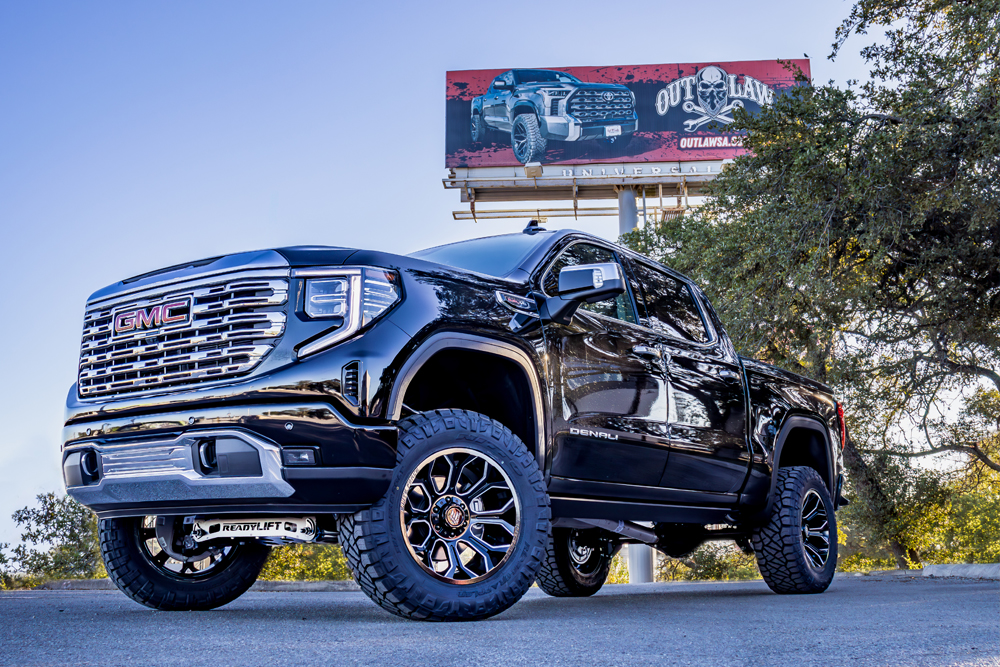
Example: For a truck buyer in a rural market, a shot of the truck bed loaded with gear can be more persuasive than the price alone. For a city commuter, a compact car parked in a tight downtown space communicates practicality and ease of use.

How Better Photos Improve SEO

Search engines don’t “see” images the way humans do, but they do measure engagement. If buyers click into your listing and spend time flipping through high-quality photos, that’s a strong positive signal.

Additionally:

  • Optimized alt text with keywords (“2023 Ford F-150 Lariat – Leather Interior”) can help listings rank higher.
  • Consistent image sizing improves page speed, which is now a Google ranking factor.
  • Proper file naming (not “IMG_1234.jpg” but “2023-toyota-camry-se-blue.jpg”) adds search relevance.

This is where great visuals and smart SEO meet — and the result is more visibility for your inventory.

The ROI of Professional Photography

outlaw truck

Let’s talk numbers. If you invest $500 a month in a professional photographer and that results in just one additional sale, the ROI is enormous. On a $30,000 vehicle with an average $2,000 gross profit, that’s a 300%+ return.

And because professional photos tend to shorten days on lot, you also save on holding costs, insurance, and floorplan interest. That means your photo investment doesn’t just make you more money — it keeps you from losing money.

Action Plan: Upgrading Your Dealership Photos

If you’re ready to improve your inventory presentation, here’s a clear path forward:

  • Audit your current listings – How many images per vehicle? Are they consistent in lighting and background?
  • Invest in proper equipment – A DSLR camera, tripod, and reflector panels can cost under $1,000.
  • Create a shot list – Every car gets 20+ photos: exterior angles, interior, close-ups, lifestyle shots.
  • Standardize your background – Clean, uncluttered, and consistent.
  • Train or hire – Either train your team in basic photography or hire a dedicated photographer.

Why Buyers Choose Dealers Who Care About Presentation

In an age where car buyers do most of their research online, your photography is often the first and only “salesperson” they meet before walking in. A dealership that invests in great visuals communicates pride, professionalism, and attention to detail — all qualities buyers value when making a large purchase.

From sedans to heavy-duty trucks, every vehicle benefits from high-quality imagery. And your bottom line will too.

Written by Bella Arbelaez, Digital Content Specialist at Bedford Advertising where she develops engaging, SEO-optimized content for dealership clients across web, social, email, and ad platforms. She combines creative storytelling with data-driven strategy to boost brand visibility, connect with target audiences, and deliver measurable result

The bedford team in a meeting

Driving Sales in the Digital Lane

The modern car buying journey doesn’t start on your lot—it starts online. Before a shopper shakes your hand, they’ve probably searched your inventory, compared financing options, watched a couple of reviews, and read dealership ratings. They might have even test-driven your competitor… virtually.

At Bedford Advertising, we understand that the race for a customer’s attention begins long before they’re ready to buy.

Behind Bedford Advertising’s Digital Department is a collaborative team of strategists, creatives, media planners, and data analysts — each bringing specialized expertise to every campaign. Since 1980, our agency has partnered with dealerships nationwide, earning long-term client relationships and national recognition, including multiple Telly Awards for excellence in automotive advertising. This blend of team talent, decades of industry experience, and award-winning work ensures that every strategy we deliver is backed by proven results and trusted expertise.

Digital Services Built for Growth

Dealerships need more than just a flashy website or an occasional Facebook post. The market is competitive, buyer habits are changing, and digital advertising is evolving daily. That’s why we offer a full suite of digital services that not only get you noticed but also move customers down the sales funnel quickly and efficiently.

Search Engine Optimization (SEO)

If your dealership isn’t showing up in search results, you’re invisible to local buyers. Our SEO strategy is built on:

  • Local keyword targeting – We identify search terms people in your market actually use, like “best truck for towing in San Antonio” or “Toyota lease specials near me.”
  • Google Business Profile optimization – Formerly Google My Business, this tool is critical for appearing in map packs and local searches.
  • Engaging, readable content – We write for humans first, search engines second, ensuring your pages convert visitors into leads.

We create high-performance, locally-optimized SEO pages that connect you with shoppers in your area, whether they’re searching for a specific model or researching service options.

Paid Search & Social Media Advertising

When done right, paid ads can be one of your dealership’s most cost-effective sales drivers. We specialize in:

  • Google Ads with precise geotargeting and audience segmentation, so you’re only paying to reach the right buyers.
  • Facebook and Instagram campaigns with a 3%+ minimum click-through rate goal—because anything less means your ad spend isn’t working hard enough.
  • Dynamic ad feeds that automatically update with your live inventory, ensuring ads are always relevant.

Creative That Converts

Your message is only as powerful as how it’s presented. Our creative team delivers:

  • High-quality video spots for CTV/OTT and social channels that grab attention in the first few seconds.
  • Custom graphics and banner ads that stand out in crowded digital spaces.
  • Direct mail and email marketing campaigns that blend traditional reach with modern targeting.
Blog chart

Local Insight + Industry Expertise

One of Bedford Advertising’s greatest advantages is how deeply we understand both the automotive industry and local consumer behavior.

For example, in a suburban Texas market, a Ford F-150 campaign might focus on towing power for weekend lake trips and long bed space for hauling. In contrast, a downtown Austin Toyota campaign might highlight fuel efficiency and ease of parking for urban drivers.

We tailor creative and targeting around:

  • Regional road habits – Campaigns for areas with heavy commuter traffic (like Hwy 121) will look different from campaigns in rural areas.
  • Seasonal trends – Summer is prime for convertible and truck promotions, while winter can highlight SUVs with safety features.

By marrying local knowledge with industry expertise, we create advertising that doesn’t just speak to buyers—it speaks their language.

Why Dealerships Choose Bedford Advertising

The automotive advertising landscape is filled with massive agencies buying up smaller ones and delivering cookie-cutter campaigns. We’ve chosen a different path.

Many of our clients have been with us for over 20 years because we believe in building personal, long-term relationships. When you work with us, you’re not just a number in a client list—you’re a partner.

Here’s why dealerships across the country choose us:

  • Authentic relationships – We get to know your people, your market, and your customers.
  • Real sales data – We measure success based on cars sold, not just clicks or impressions.
  • Nationwide flexibility – No territory limits mean we can support you wherever you do business.

Turning Engagement into Action

Behind the scenes

It’s easy to get caught up in “vanity metrics” like likes, shares, or even website visits. But at the end of the day, those numbers mean nothing if they don’t lead to actual sales.

At Bedford Advertising, our approach to digital marketing is conversion-first. We design every campaign—whether SEO-driven, paid ads, or creative video—with a clear next step for the shopper. That could mean:

  • Clicking through to book a test drive.
  • Calling dealerships directly from an ad.
  • Filling out a financing pre-approval form.

By reducing friction between interest and action, we help your sales team spend less time chasing leads and more time closing deals.

Your Next Sale Could Start Here

If you’re ready to turn online engagement into actual sales, Bedford Advertising has the tools, talent, and track record to make it happen. We’ve spent decades perfecting the art of connecting buyers and dealerships, and our strategies work—whether you’re a small-town dealer or part of a large auto group.

About Bedford Advertising

Founded in 1980 by Patti Bedford, Bedford Advertising is a full-service automotive marketing agency specializing in innovative, targeted strategies that increase dealership market share. With decades of industry experience, long-term client partnerships, and national awards including multiple Telly Awards, Bedford is recognized as a trusted leader in dealership advertising.

Harley Mailer

In a digital-first world, direct mail might seem outdated—but it continues to outperform expectations, especially in the automotive industry. Backed by data and evolving technology, direct mail marketing remains one of the most profitable and reliable channels for dealership growth.

In this post, we’ll explore why direct mail still thrives in 2025, which campaigns work best, and how to integrate it with modern strategies to maximize ROI.

Why Direct Mail Still Works for Automotive Advertising

Top-performing dealerships already know what new research keeps proving: direct mail gets attention and drives action. As digital fatigue increases and consumers become numb to banner ads and email overload, physical mail stands out.

According to USPS neuromarketing research:

  • Direct mail holds attention 118% longer than digital ads
  • It creates a 20% higher motivation to act
  • Physical mail is more memorable and trusted than digital content

A well-executed mailer doesn’t just inform—it moves metal. Whether you’re launching a tent sale or driving service appointments, direct mail can deliver measurable ROI when executed with intent and personalization.

Direct Mail: A Versatile Tool for Key Dealership Goals

1. Drive Showroom Traffic

Promote buyback events, trade-in incentives, or model-year clearance sales with urgency-based creative. Properly segmented mailers with strong CTAs like “$1,000 Over KBB” or “No Payments for 90 Days” generate walk-ins and web form fills.

2. Increase Fixed Ops Revenue

Trigger service reminders based on mileage, warranty expiration, or last visit date. Combine mailers with QR codes for scheduling, follow-up SMS, and coupon codes to boost service lane activity.

3. Stimulate Trade-Ins and Lease Conversions

Equity mailers and lease pull-ahead offers remain some of the most profitable strategies. When paired with manufacturer incentives, these campaigns create urgency while replenishing your used inventory pipeline.

Harley Mailer 2

Direct Mail in Action: A Chevy Dealer Case Study

A regional Chevy dealership mailed 10,000 personalized pieces to out-of-warranty customers, each featuring:

  • Variable Data Printing (VDP) with VIN and service history
  • $50 service credit
  • QR code to schedule online

Results over 14 days:

  • 4.6% response rate
  • 297 service calls
  • $21,000 in service revenue
  • $2.83 per-piece ROI

This campaign proves how targeted, data-rich mail can outperform digital in real-world dealership environments.

Targeting Smarter with Direct Mail in 2025

Modern mail isn’t mass-produced—it’s hyper-personalized and data-driven. Dealerships now build lists based on:

  • Vehicle year/make/model
  • Lease/finance status
  • Household income and lifestyle
  • Credit score bands
  • ZIP code radius or conquest markets

Sample Segments That Convert

Audience TypeVehicle InterestsOffers That Work
Young FamiliesSUVs, crossoversLease upgrades, safety feature spotlights
Trades/Blue CollarTrucks, 4x4sTruck Month rebates, utility bundles
RetireesSedans, hybrids, EVsConcierge service, low-rate financing
Custom BuyersOff-road buildsLift kit mailers, VIP mod event invites

Aligning the offer and creative with buyer lifestyle is critical to success.

Elements of a High-Converting Mailer

To break through the mailbox clutter, your piece must include:

  • A bold, benefit-driven headline
  • Personalized content (name, VIN, past services)
  • Dealer branding and relevant local visuals
  • Clear, time-sensitive call to action
  • QR code, vanity URL, or dedicated phone line
  • Expiration date or RSVP window

Great mail isn’t about volume—it’s about precision, relevance, and design.

Omnichannel Integration: Direct Mail + Digital

The most successful campaigns don’t stop at the mailbox.

Here’s how smart dealerships extend the impact:

  • Retarget mailed households with IP-based display ads
  • Follow up 3–5 days post-delivery via SMS or email
  • Log activity in the CRM to measure attribution
  • Track ROI using matched sales, QR codes, and dedicated CTAs

This synergy boosts both response rates and revenue—especially when you match back to actual closed deals.

Lincoln Mailer

Best-Performing Automotive Mailer Types (Updated 2025)

Campaign TypeAvg. Response RateUse Case
Pre-Approval Letters3.5–5.2%Attracting loan-ready buyers
Lease Pull-Ahead2.0–3.8%Preventing off-brand defections
Equity Mailers3.0–4.5%Driving trade-ins and showroom visits
Fixed Ops Coupons2.5–6.0%Increasing service lane traffic
VIP Event Invites3.5–7.2%Building loyalty through exclusivity

Even at lower response rates, mailers often close at a higher percentage than digital leads—making them cost-effective for most franchise and independent stores.

FAQs: Direct Mail for Auto Dealerships

Is direct mail still effective in 2025? Absolutely. It’s especially powerful when integrated with digital and CRM tools to track and personalize communication.

How much does a direct mail campaign cost? Most campaigns fall between $0.50 and $1.25 per piece, depending on design, stock, personalization, and postage.

How do I track results? Use:

  • CRM matchbacks
  • Tracked phone numbers
  • QR codes or PURLs
  • Redemption codes

This gives you full attribution from mailbox to dealership floor.

Mail That Moves Metal

Direct mail isn’t just alive in 2025—it’s smarter, more targeted, and delivering better ROI than ever. For auto dealers looking to increase visibility, boost appointments, and drive real-world results, direct mail belongs in the budget.

Want Your Direct Mail to Deliver Results? Call Bedford Advertising at (972) 458-1150

Let’s build a campaign that drives results from the mailbox to the showroom floor.

AI is truly transforming the way we connect with customers, making communication more personalized and efficient. At automotive dealerships, tools like virtual assistants, chatbots, and AI-driven customer relationship management (CRM) systems are becoming the norm. These friendly AI tools are available 24/7 to answer customer questions, help with vehicle inquiries, schedule test drives, and even assist with financing options. 
 
The impact of AI doesn’t stop there; it’s also enhancing how dealerships operate overall. With AI, you can improve customer engagement, manage inventory more effectively, set competitive prices, boost marketing efforts, and streamline after-sales services. By embracing these technologies, dealerships can create smoother operations and, most importantly, provide better experiences for their customers. As AI continues to grow and evolve, its involvement in the automotive industry will only deepen, changing the way we do business and interact with our customers for the better. 
 
In today’s automotive market, embracing AI isn’t just a nice-to-have—it’s a must for dealerships that want to thrive. Ignoring AI could lead to missed sales opportunities and less loyal customers. The digital future of the automotive industry is here, and AI will be right at the heart of this exciting transformation!